
Cabling is the part of the job nobody sees once the walls are closed, which is exactly why it is worth doing properly. Everything else sits on it: the WiFi, the cameras, the phones, the door readers, the point of sale. A network that keeps misbehaving is very often a cable that was never tested, a termination that was never finished, or a bundle behind a cabinet that nobody can trace.
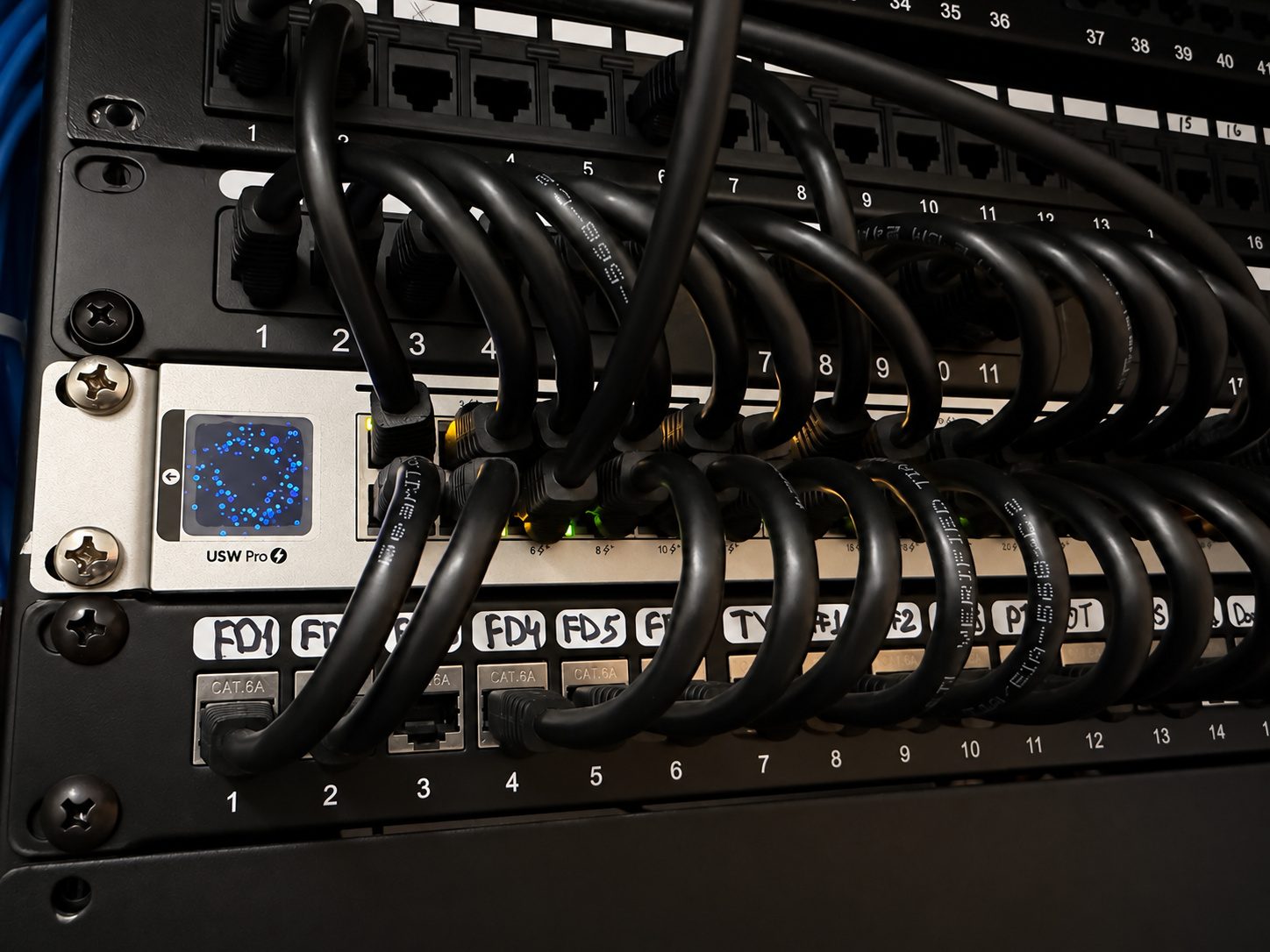
We run Cat6 and Cat6A through proper pathways, terminate on patch panels and jacks, dress the rack so it can be worked on, and label every run at both ends. Then we test every run and hand you the results and a record of what went where. The photo above is a typical result: the panel reads what each port serves, and the jack at the desk says the same thing.
What’s included
- Data cabling
- Cat6 and Cat6A runs specified for the distances and speeds you actually need.
- Voice and video
- Wiring for phones, displays, paging and intercom alongside the data infrastructure.
- Patch panels and racks
- Terminated, dressed and mounted properly rather than a bundle behind a cabinet.
- Labeling
- Every run labeled at both ends. This is the difference between a ten-minute fix and an afternoon.
- Testing and certification
- Runs tested rather than assumed, with results handed to you.
- As-built documentation
- A record of what was run where, so the next person is not tracing cable by hand.
How it works
- Plan the runsDrop locations, pathways and rack position worked out against the floor plan and the building.
- Pull the cableRouted through proper pathways, away from electrical interference, respecting the building’s constraints.
- Terminate and dressJacks, patch panels and rack work finished cleanly and labeled as we go.
- Test and documentEvery run tested, results recorded, and documentation handed over.
Who it’s for
We install and support this across a range of operational environments throughout New York City.
Typically: Corporate Workspaces, Industrial & Logistics, Education Facilities, Hospitality & Restaurants and Retail & Showrooms.
Common questions
Do you work as a low voltage contractor?
Yes — low voltage is most of what we do: data and voice cabling, camera and access control wiring, and the pathways and terminations that go with them. We work across the five boroughs, in occupied offices, restaurants, clinics and warehouses.
Cat6 or Cat6A?
Cat6 covers most offices comfortably. Cat6A is worth it for longer runs, higher-density WiFi and anywhere you expect to outgrow a gigabit. We will tell you which applies rather than defaulting to the more expensive one.
Can you work in an occupied space?
Yes. Most cabling work in NYC happens around a working business — we schedule the disruptive parts outside your hours.
Do you handle old buildings?
Frequently. Much of NYC’s commercial stock is old, and pathways are the hard part. That is exactly what the site walk is for.